

Phage therapy: an alternative to antibiotics?
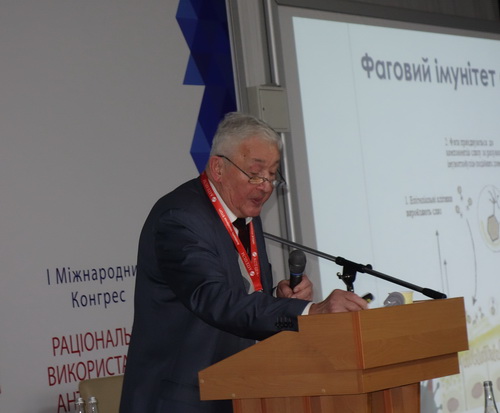
On November 15-16, 2018, the 1st International Congress "Rational Use of Antibiotics. Antibiotic Resistance Stop!" was held in Kyiv. Professor V.P. Shirobokov, Head of the Department of Microbiology, Virology, and Immunology at the Bogomolets National Medical University, Academician of the National Academy of Sciences and the National Academy of Medical Sciences of Ukraine, dedicated his report to bacteriophages as a possible alternative to antibiotics.
 Doctors and scientists from around the world gathered in Kyiv to discuss one of the most pressing problems in modern medicine: the spread of antibiotic-resistant bacterial strains. Antibiotic-resistant infections claim more and more lives each year. WHO experts warn of the inexorable approach of the day when humanity will once again be defenseless against pathogenic bacteria.
Congress participants discussed global experience in monitoring and containing the spread of antibiotic resistance, methods for treating multidrug-resistant infections in clinical practice, the need for rapid identification of pathogens and determination of their susceptibility to antibiotics in the treatment of infectious pathologies, as well as alternative treatment options for bacterial infections.
Phage therapy as an alternative to antibiotics was the topic of a report by Vladimir Pavlovich Shirobokov , Head of the Department of Microbiology, Virology, and Immunology at the A.A. Bogomolets National Medical University, Academician of the National Academy of Sciences and the Academy of Medical Sciences of Ukraine.
Video recording of the report:
Professor Shirobokov reminded the audience that bacteriophages (phages) were discovered over 100 years ago by the French scientist Félix d'Hérelle, but even earlier, in 1898, a similar phenomenon of bacterial lysis was described by microbiologist Nikolai Gamalia. Since then, phages have been extensively studied, leading to important discoveries in genetics and molecular biology, including the proven role of nucleic acids as a factor in heredity. Phages have found application not only in medicine but also in biotechnology, genetic engineering (as vectors), nanotechnology, agriculture (to protect plants and animals from infections), the food industry (for antimicrobial treatment of food products), and as disinfectants for premises and equipment. This year, the Nobel Prize was awarded to the developers of phage display—a method that allows the production and study of new proteins and peptides using bacteriophages.
The speaker noted that phages likely arose simultaneously with bacteria approximately 3.5 billion years ago and coevolved with their prokaryotic hosts. Within a bacterial cell, phages can behave in two ways: during the lytic cycle, phages replicate within the bacterium and destroy it upon release into the environment; and during the lysogenic cycle, the phage integrates its DNA into the bacterial chromosome and can coexist with the host for a long time without causing any symptoms.
Life cycles of bacteriophages

The number of bacteriophage species is many times greater than the number of bacterial species. They inhabit every corner of the biosphere, including the open cavities of living organisms. For example, metagenomic analysis has shown that the human microbiome contains more phages and species than bacteria. The existence of so-called phage immunity has already been proven: phages integrate into the mucus layer of the intestinal mucosa and protect enterocytes from pathogenic and opportunistic bacteria without harming the normal microflora. Professor Shirobokov noted that bacteriophages are an important component of the microbiome and suggested that in the future, they will be used in clinical practice as viral probiotics.
Phages were first used to treat human infectious diseases by Félix d'Hérelle, who coined the term "living drugs." They were effective, although their high specificity limited their use. After the discovery of the first antibiotics in the 1940s, interest in phages waned in most Western countries. However, phage therapy has recently experienced a renaissance due to the spread of antibiotic resistance.
Vladimir Pavlovich noted the main areas of phage use in modern medicine:
- phage therapy - the use of bacteriophages for therapeutic purposes (routes of administration: oral, irrigation of infected wounds, injection of the site of inflammation, etc.);
- phage prophylaxis - prevention of infection in epidemic foci, fight against hospital infections, etc.;
- Phage diagnostics - the use of phages for identification and species differentiation of bacteria;
- Phage typing is one of the methods of intraspecific differentiation of bacteria.
Bacteriophages are safe and non-toxic to the human body. They quickly reach the site of infection when administered by various routes, begin to act within 2-4 hours after administration, and are eliminated after the infection process has ended. A significant advantage of phages is that they can be used in conjunction with antibiotics.
V.P. Shirobokov explained that phage therapy is performed using commercially available medications or customized preparations created for a specific patient after the causative bacteria has been isolated. Phage preparations can be single-component or combined. Recently, so-called "phage antibiotics"—phage enzymes (phagolysins) capable of specifically interacting with and destroying certain types of bacteria—have been introduced into medical and veterinary practice. Resistance to them has not yet been documented.
Phage preparations must meet the following criteria:
- contain only virulent phages (do not contain temperate phages);
- phages in the preparation must reproduce in the host bacterium with a high yield of active viral particles;
- phages in the preparation must retain lytic activity during long-term storage;
- phages in the preparation should not negatively affect representatives of the normal human microbiota.
Advantages of phage preparations over antibiotics
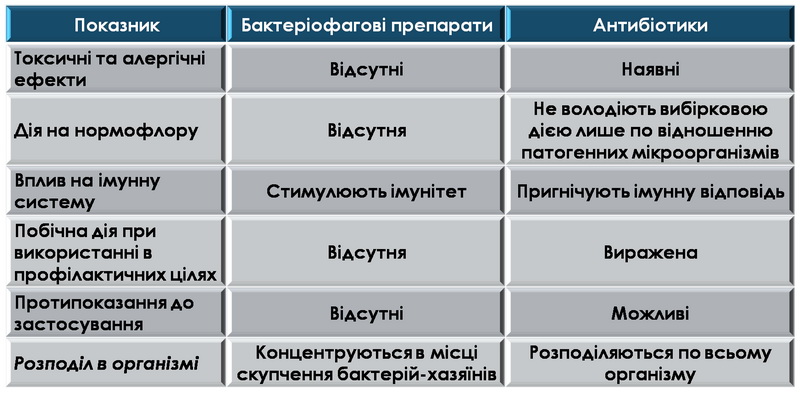
Professor Shirobokov noted that phage therapy is currently primarily an adjunct treatment for infectious diseases, used in conjunction with antibiotics. However , in cases of multiple antibiotic-resistant pathogens, phage therapy can serve as a leading, truly alternative, treatment method.
Currently, the widespread use of phage preparations is limited by two factors: the exceptional specificity of phage-bacteria interactions and the development of bacterial resistance to phages. Personalized phage therapy, which is successfully used in several countries, could solve these problems. With precise identification of the pathogen and the availability of a phage library, the creation of personalized phage preparations takes only a few days.
When using commercial phage preparations, preference should be given to phage cocktails that are constantly updated with local strains, and before treatment, it is imperative to determine the sensitivity of pathogens to the phage preparation.
Vladimir Pavlovich noted what he considered to be promising areas of application of bacteriophages in clinical practice:
- treatment of dysbiotic conditions when used in combination with probiotics;
- fight against somatic pathology (gastritis, Helicobacter infection, etc.);
- fight against bacterial carriage;
- prevention of development of nosocomial infections.
In conclusion, Professor Shirobokov noted that over the past 100 years, bacteriophages have enriched modern science with fundamental discoveries and found widespread practical application, primarily in medicine. He expressed confidence that the next century will be even more productive for bacteriophages.
